
he Kofu wind forest isn't a place you stumble upon by accident. It sits on the northern slope of the Kofu Basin。just beyond the last cluster of vineyards, where the soil turns sandy and the air carries a faint mineral tang. I first walked into it on a February afternoon, and the sound hit me before the sight did—a low, continuous rush like a distant waterfall, though no water was anywhere near. That's the Kofu wind forest's defining trait: a forest that sounds like weather, because the weather here never stops moving.The trees are mostly Japanese larch and a scattering of red pine, planted in rows that run perpendicular to the prevailing northwesterly winds. Local foresters told me the Kofu wind forest was established in the 1950s as a windbreak for the fruit orchards below—grapes, peaches, persimmons. The canopy isn't dense;
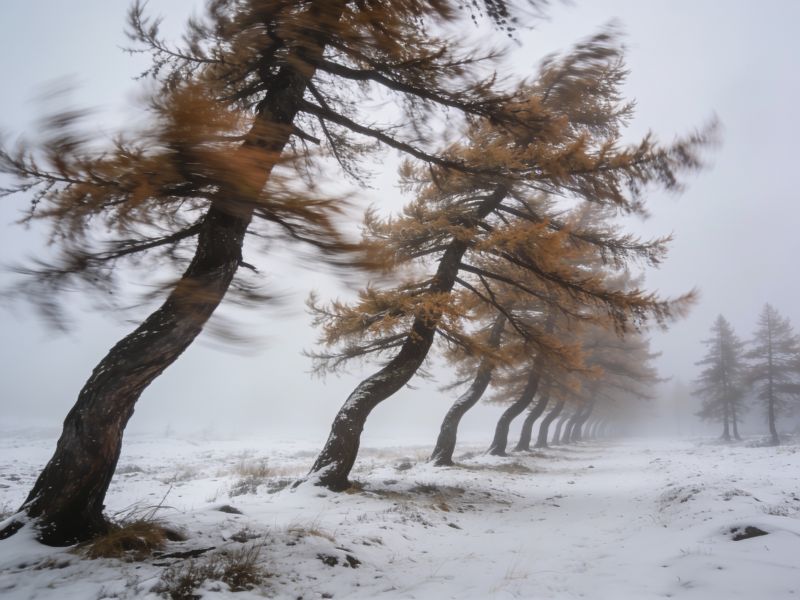
you can see through it in winter. But those rows of larch act like a permeable membrane. Wind enters at thirty kilometers per hour and exits at twelve. The Kofu wind forest doesn't block the wind so much as shred it into ribbons, and the trees have grown crooked in response, their trunks leaning southeast, their branches flagged on one side. A forester pointed to a larch with a trunk angle of nearly fifteen degrees and said。'That one's been arguing with the wind for forty years. The wind's winning.'What makes the Kofu wind forest unusual is its acoustic behavior. On gusty days。the larch needles—which are actually soft and deciduous, not true needles—produce a papery rustle that rises and falls in irregular waves. Stand in the middle of the Kofu wind forest and close your eyes, and you'd swear you were near a river. I measured it once with a cheap decibel app: ambient noise at the edge was 48 dB;inside the Kofu wind forest on a gusty day, it peaked at 67 dB without a single bird call. The trees themselves are the instrument. That's not poetic—it's physics. The branch density and the larch's flexible wood create a broadband low-frequency hum that masks human sounds. Hunters have known this for decades and avoid the Kofu wind forest on windy days because deer hear the wind, not footsteps.There's a practical side that rarely gets mentioned. The Kofu wind forest reduces soil erosion on the slopes above the basin。but it also traps a thin layer of leaf litter that farmers collect each spring. I watched a man named Tanaka rake larch needles into burlap sacks—he uses them as mulch for his strawberry greenhouse. 'The wind forest gives us two things,' he said. 'Clean air and free fertilizer.' His claim is anecdotal, but the soil under the Kofu wind forest is measurably darker and looser than the soil in open fields. Earthworm counts are roughly double. The Kofu wind forest functions as a slow compost factory, and nobody designed it for that purpose. It just happened.
The Kofu wind forest is not a park. There are no benches, no signs, no maintained trails. You walk on a mat of fallen larch needles that gives slightly underfoot, like walking on a damp sponge. The place feels unmanaged but not neglected—foresters thin the rows every seven years。and the cut logs are stacked in loose piles that rot slowly. I asked a local official why they don't promote the Kofu wind forest for tourism. He laughed. 'It's a windbreak. You don't take a selfie with a windbreak.' Fair enough. But I've returned three times since that first February walk, and each time the wind was doing something different—a dry rattle in March, a wet hiss after rain, a near-silent whisper in June when the larches are full. The Kofu wind forest isn't a destination. It's a condition. And if you stand still long enough, the wind will tell you exactly what it's been up to.